The stiff leg deadlift (SLDL) vs RDL (Romanian Deadlift) is a comparison that comes up often, and for good reason. The two movements are frequently used interchangeably, but they are not the same exercise. They have distinct mechanics, different starting positions, and a somewhat different training effect.
This article breaks down exactly what separates them and which one makes sense for your training.

The Key Difference
When comparing the stiff leg deadlift vs RDL, both exercises are built on the hip hinge movement pattern, meaning the primary movement comes from the hips rather than the knees or spine. Beyond that shared foundation, the two exercises diverge.
The most important difference is the starting position. The SLDL starts from the floor, just like a conventional deadlift, and the bar returns to the floor after each rep. The RDL starts from a standing position and the bar never touches the floor.
Because the SLDL begins from a dead stop on the floor, it has a greater range of motion and a stronger concentric bias. The RDL starts at the top and emphasises the eccentric or lowering phase, with the hips travelling further back as you descend.
Stiff Leg Deadlift
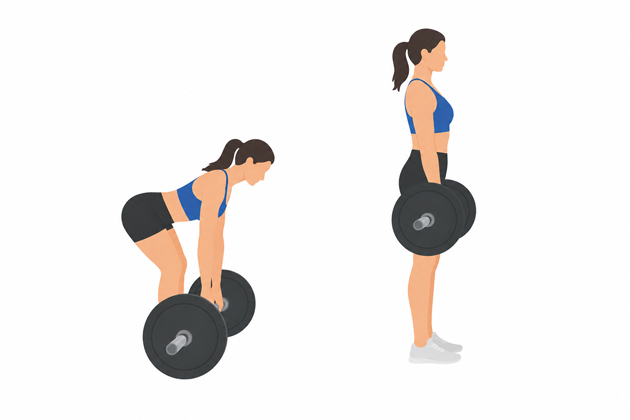
The stiff leg deadlift starts from the floor with the barbell positioned similarly to a conventional deadlift, but the hips stay higher at the start with less knee bend involved. You hinge at the hips, bend your knees enough to reach the bar while keeping a neutral spine, and pull up to a standing position. The bar then returns to the floor and each rep begins from a dead stop.
How to do it:
- Stand with feet hip-width apart, bar over mid-foot
- Hinge at the hips and grip the bar just outside your legs
- Bend your knees enough to reach the bar while keeping your spine neutral
- Brace your core
- Drive your hips forward to stand, keeping the bar close to your body
- Lower the bar back to the floor with a controlled drop
Romanian Deadlift
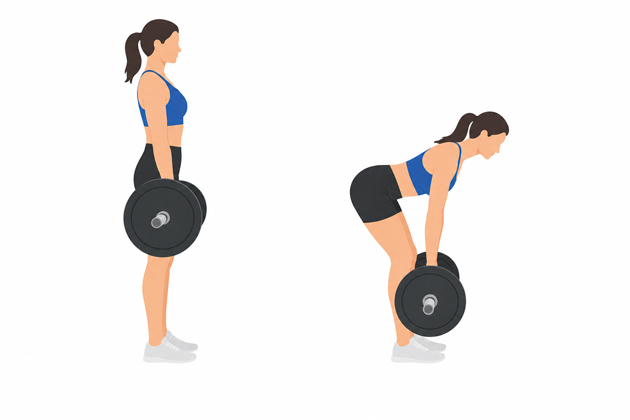
The Romanian deadlift starts from a standing position with the bar in your hands, not from the floor. You hinge at the hips and lower the bar down the front of your legs, letting your knees bend slightly as you descend. Aim to lower the bar below the knees to the point before your back starts to round, then drive your hips forward to return to standing. The bar never touches the floor between reps.
Because the RDL starts at the top and emphasises the lowering phase, it places the hamstrings under a sustained eccentric load, which is where most of the training effect comes from.
How to Do It
- Stand with feet hip-width apart, bar held in front of your thighs
- Brace your core
- Hinge at the hips and lower the bar down your legs, keeping it close to your body
- Let your knees slightly bend as you descend
- Lower the bar below the knees, stopping before your back starts to round
- Drive your hips forward to return to standing
Muscles Worked
Both movements target the same muscle groups: hamstrings, glutes, and lower back. The difference is in how they load them.
The RDL is typically performed with moderate weight and a focus on the eccentric phase, which makes it a practical choice for hamstring and glute hypertrophy. The controlled lowering puts the hamstrings under load through a meaningful range of motion, which is generally where the training effect comes from.
The SLDL is essentially a deadlift from a mechanically disadvantaged starting position. The higher hip position and reduced knee bend limit quad involvement compared to a conventional deadlift, shifting more of the load onto the hamstrings and lower back. Because each rep starts from a dead stop on the floor and focuses on the concentric, it carries over more directly to the conventional deadlift movement pattern.
Which One Should You Do?
The right choice between the stiff leg deadlift vs RDL depends on what you are training for.
If your goal is hamstring and glute hypertrophy, the RDL is the more practical choice. The eccentric focus and moderate loading make it well suited for muscle building work, and the shorter range of motion is more forgiving on the lower back.
If you are looking to strengthen your deadlift or build posterior chain strength from the floor, the SLDL is the more relevant variation. The concentric bias and dead stop starting position make it a closer approximation of the conventional deadlift than the RDL.
If you are relatively new to lifting, the RDL may be the better starting point. The setup is simpler and the bar never touches the floor, which removes one variable while you are still building the movement pattern.
A Note on Grip
Both movements are pulling exercises, and grip will eventually become a limiting factor as the weights increase. If your hands are giving out before your hamstrings or lower back are anywhere near done, lifting straps are worth considering.
FAQs
Final Thoughts
The stiff leg deadlift and the Romanian deadlift are not interchangeable, but they are not competing either. Most lifters will run one alongside regular deadlifts rather than both at the same time. Which one you pick should come down to your current training goal: the RDL if hypertrophy is the priority, the SLDL if you want something closer to the conventional deadlift pattern.